Select Page
Room temperature Geysir

Room temperature Geysir

Room temperature Geysir

nuit blanche 
Musée de d’Art Moderne de Ville de Paris
Scènes Nordiques, January 1998

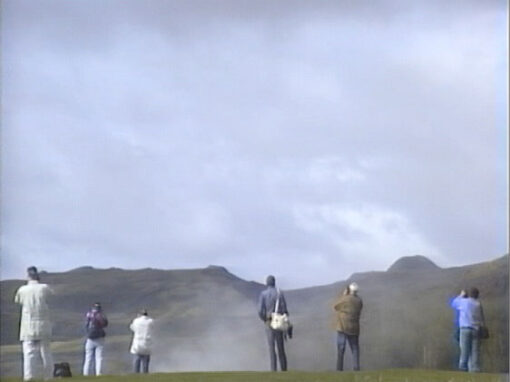
Ósk Vilhjálmsdóttir‘s ‘Room Temperature Geyser’ is a narrative work which shows a hot spring shooting out of the ground in real time. The tourists who have gathered around it try to capture the eruption on film but such an attempt requires both patience and speed, for a geyser can be capricious, a real tease. The scene is shot with a static camera, with no concern for the spectacle. What interests the artist is not so much the eruption of the famous geyser as the ritual of human behaviour in the face of a natural phenomenon. The human figures are seen from a distance and nearly always have their back to us: virtually immobile, waiting (eight minutes), they seem gradually to lose all personality, and the process of reification grows stronger with each repetition.

(Gunnar B. Kvaran)


The Boiling Curve

At sea level water boils at 100°C, but at higher altitudes the boiling point becomes lower as the air pressure decreases. Conversely, the boiling point is raised with increasing pressure, as exerted by a column of water. This relationship is known as ‘the boiling curve’. The temperature of water under hydrostatic pressure, deep in the earth’s crust, may be up to several hundred degrees centigrade. From chemical studies it has been calculated that the temperature of the deep geyser reservoir is around 260°C.

Round Table

Round Table

Round Table

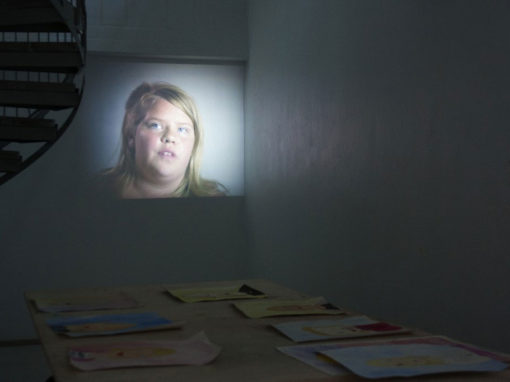
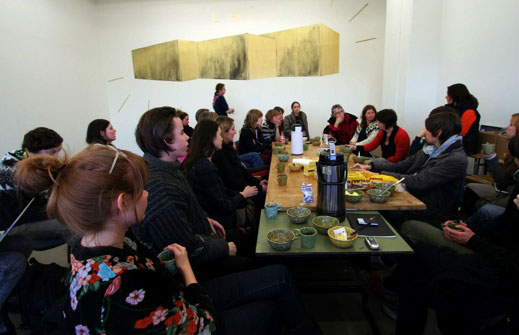
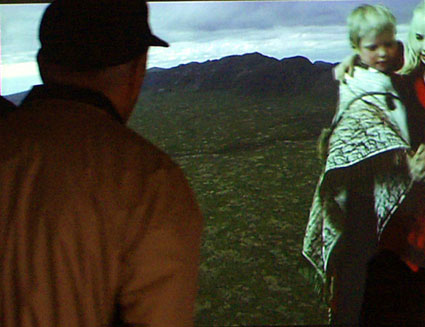
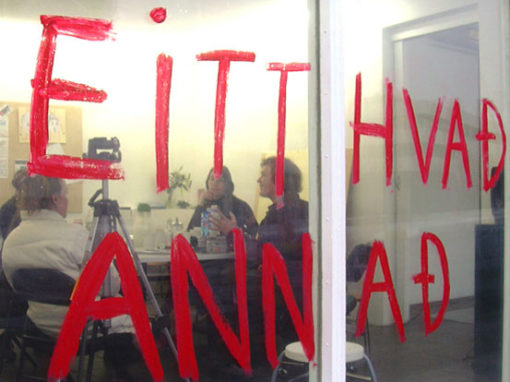
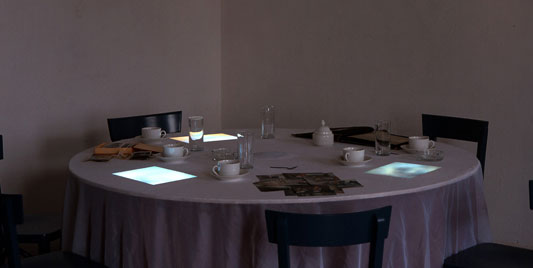
From a room, voices were heard speaking in tongues. It was as if a conversation was taking place. Sometimes only one voice was heard, sometimes all the voices simultaneously, and in between silence reigned. Upon entering the room one saw a large table surrounded by chairs. The room was dimly lit. The table was covered with a thin white tablecloth; there were coffee cups and ashtrays on top of it and in front of each chair there were family photographs. Through the thin tablecloth pictures could be seen on three video-screens, which were encased in the table. Three screens depicted life-size hands leafing through individual photographs. The voices emanated from a small loudspeaker that was encased in the middle of the table.

As an art student in Berlin I visited acquaintances, who were foreigners in spite of their residence. They showed me photographs they had brought from their home country. They spoke in their mother tongue, which some of them no longer master completely. Their stories turned out to have nostalgic overtones and I experienced a sense of sorrow over the loss of home and friends. I recorded the conversation and videotaped the hands that browsed through the photographs.

The Window

The Window

The Window

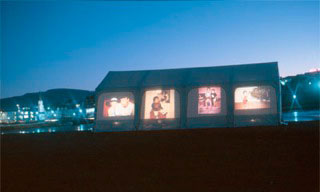
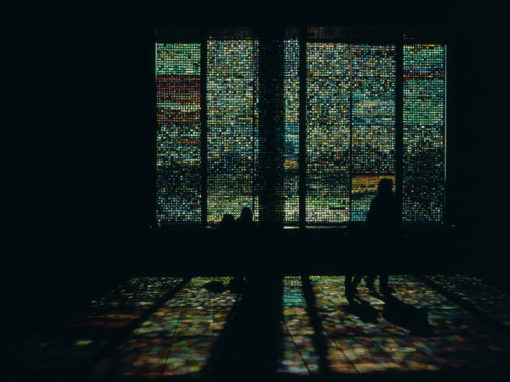
Ten thousand slides are posted on windowpanes in in the main hall of the Reykjavik City Hall.

I found the slides at the flea market. Strange that one can buy such private and intimate things. Thus I am witness to the most private family stories but at the same time I discover that the intimate motives form a familiar refrain and the same family events are repeatedly photographed: baptism, birthdays, weddings, children, Christmas, travel, friends, funerals, grandchildren and great-grand-children… One must come close to the window, in order to discern the individual motives of the photographs. At a distance they dissolve into a sea of colors.

During daytime the light shines through the slides into the room. When it becomes dark outside, light is generated from within and projects the slides to the outside. The slides covered the entire area of the large windows. Slide transparencies are not resistant to fading in sunlight. Therefore, the images faded away over the time of the exhibition until all that remained were faint marks, traces of things that once were.

Ósk has used family snapshots she found in Berlin fleamarkets as material for her work. These were slides that families had made over time and which had later ended up at flea- markets because no other family members were interested in them. These were obsolete family pictures, images that had once been the joy, and centerpiece, of the registration of family history but that had now lost that purpose when no one felt a connection to those images and memories.


Ósk utilized this found imagery in many ways over a period of time. 
In an exhibition in I8 Gallery in Reykjavik Ósk exhibited the images more as they had originally been presented, with a slide projector on a screen. Except that the screen was no longer set up in a living room, as it had been originally; the images were projected outwards from the closed gallery space onto the window fronting the street. The traditional exhibition space was closed to the audience, which was able to view the show on the “display”-window of the gallery. Thus the family pictures of unrelated Berliners were projected outwards onto a narrow street in the centre of Reykjavik.


Pin It on Pinterest