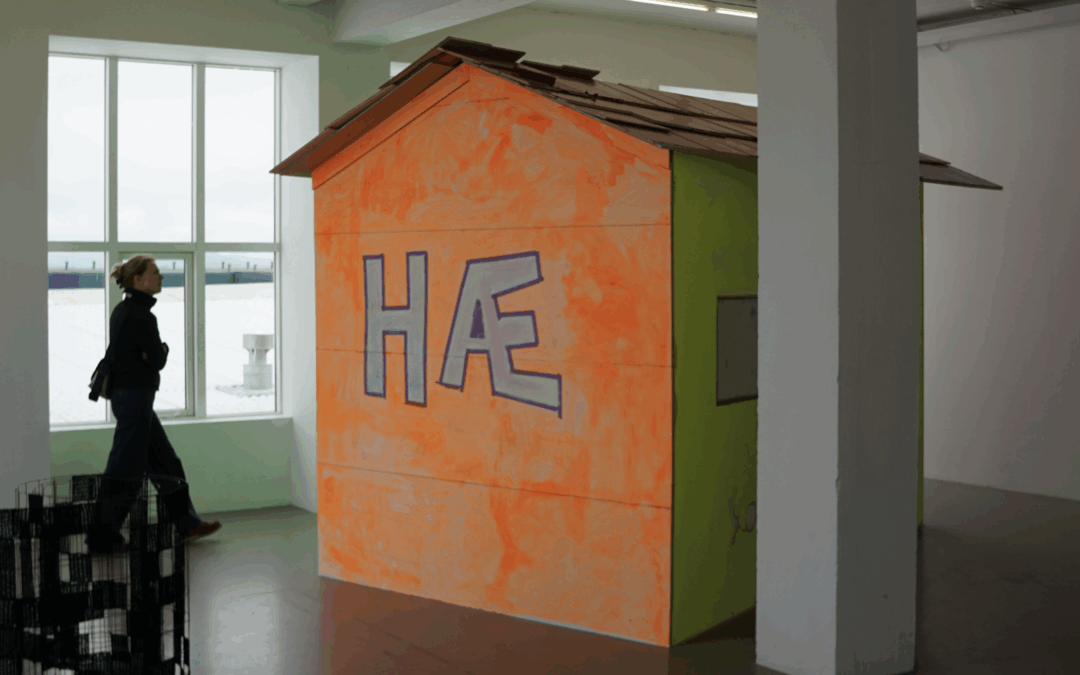
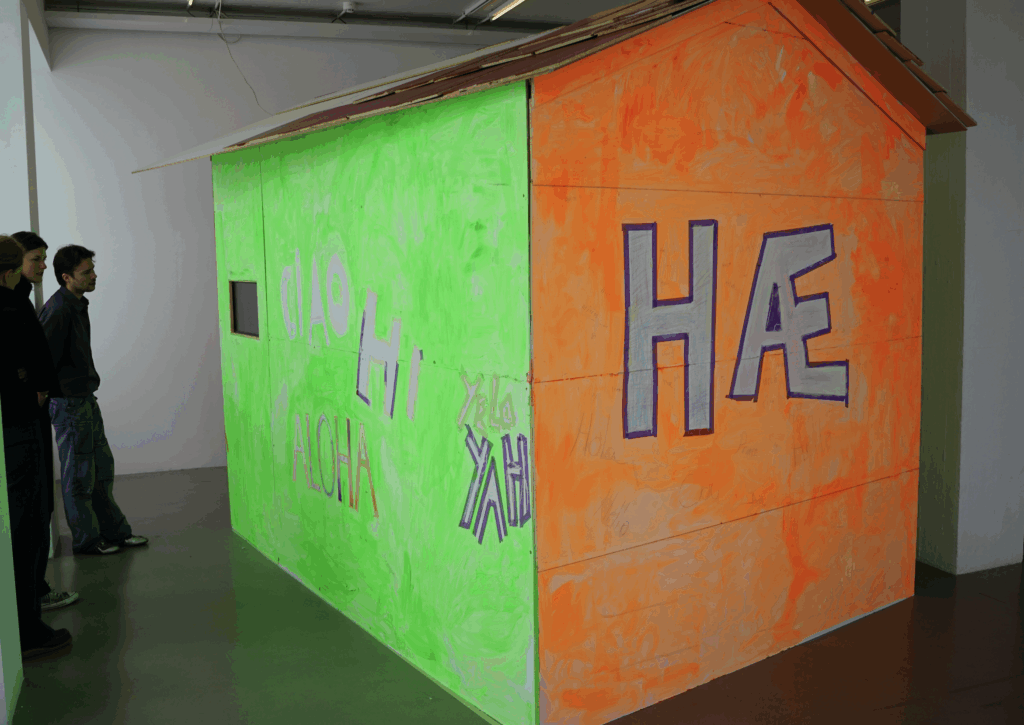
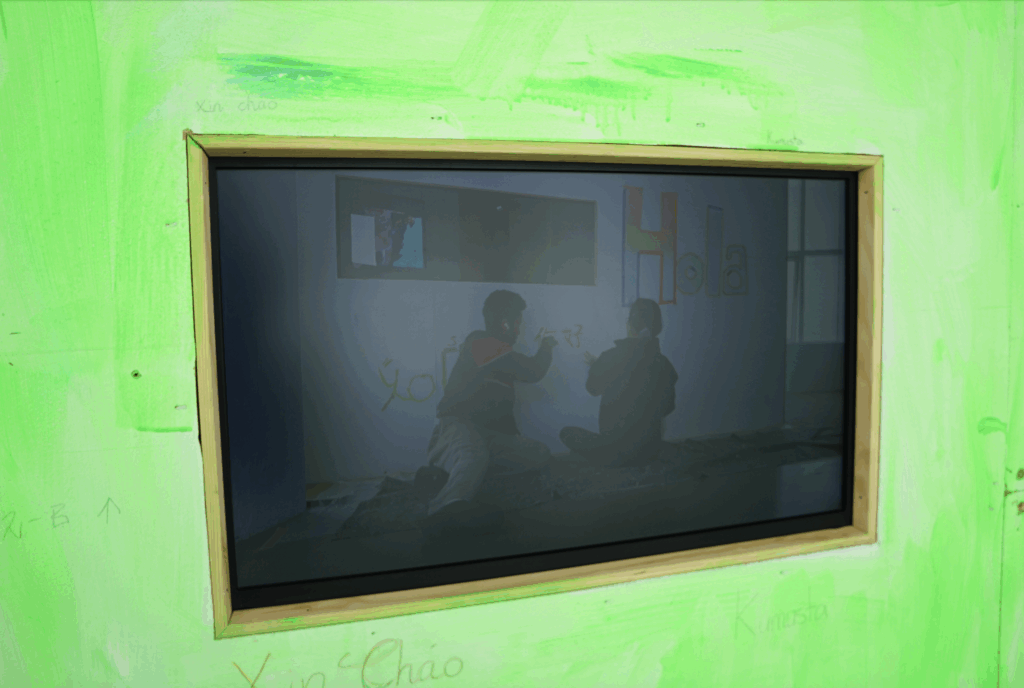
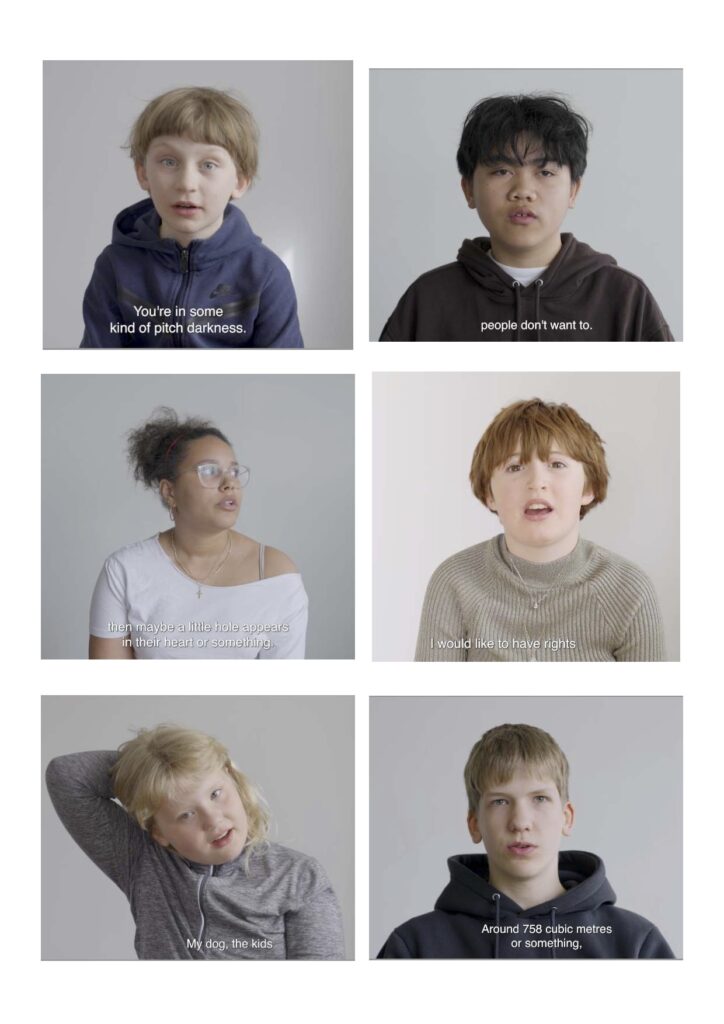
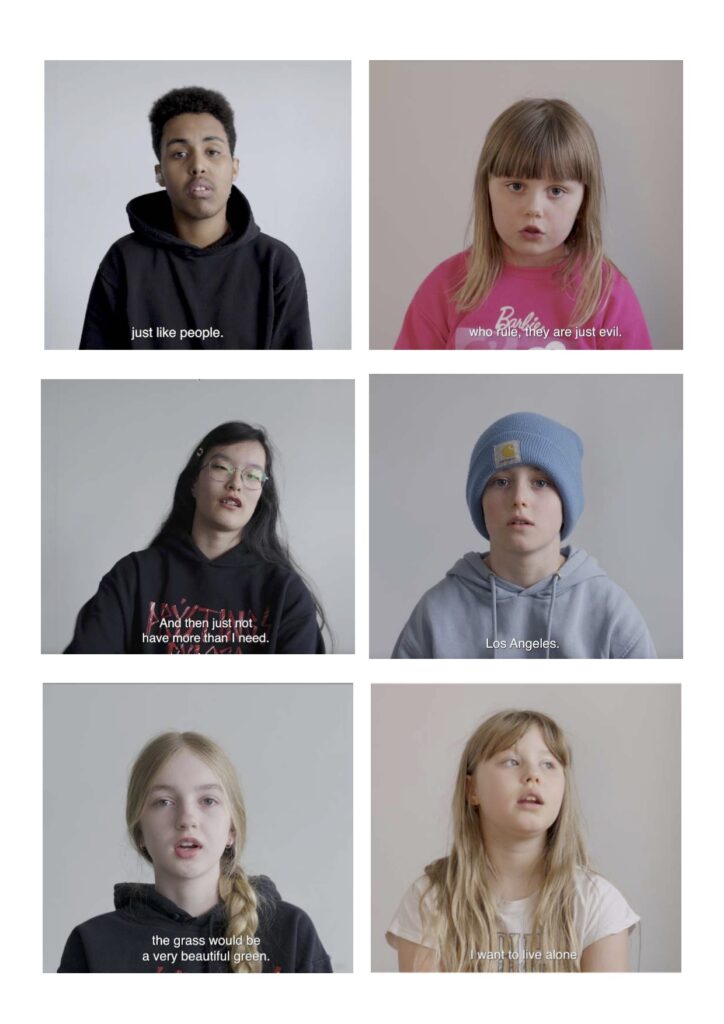
The video sculpture was developed in collaboration with children and teenagers from central Reykjavík and Breiðholt (Fellaskóli).
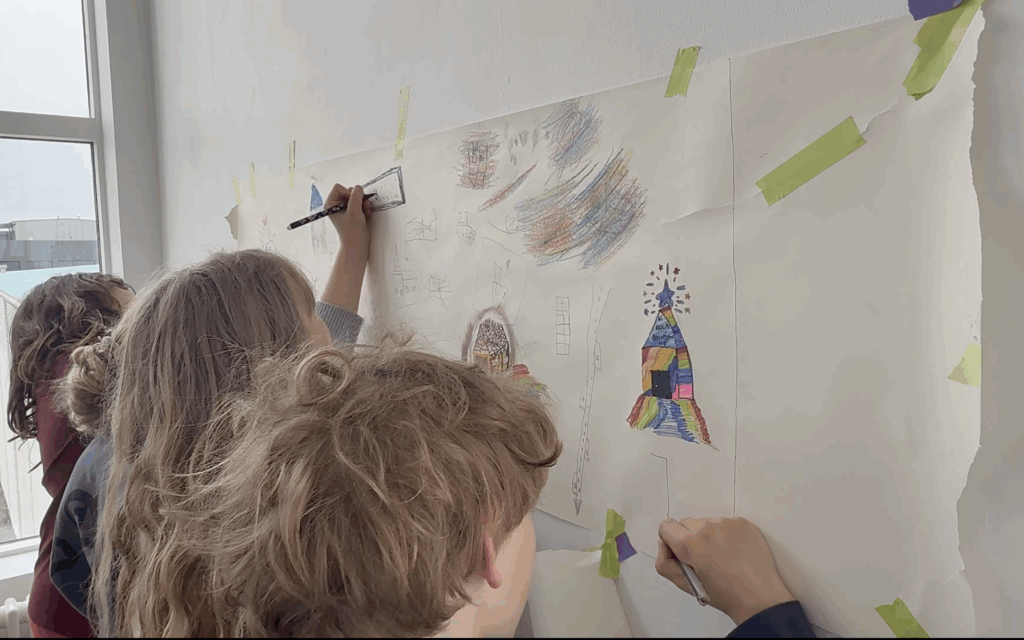
Through individual interviews, the children were invited to reflect on how they would like to live in their life, how their dream home should look like, who would live there, what constitutes for them a good life.
The group then came together for a week-long workshop at Kling & Bang, where they designed, built, painted and transformed a small house that became a home for their voices and ideas.
The work was presented in the exhibition To Move an Ancient Stone (Að færa fornan stein) in Kling & Bang.
Curated by The Other Side; Hugo Llanes, Janosch Bela Kratz and Katerína Spathí. The exhibition was a part of the Reykjavík Arts Festival 2026.
Landnám VII is part of an ongoing series initiated in 2002. Each work takes a different form, shaped by its particular place, time and participants.
Three generations of mothers and daughters, Borghildur Óskarsdóttir, Ósk
Vilhjálmsdóttir and Hulda Ragnhildur Hjálmarsdóttir, collaborate on the work.
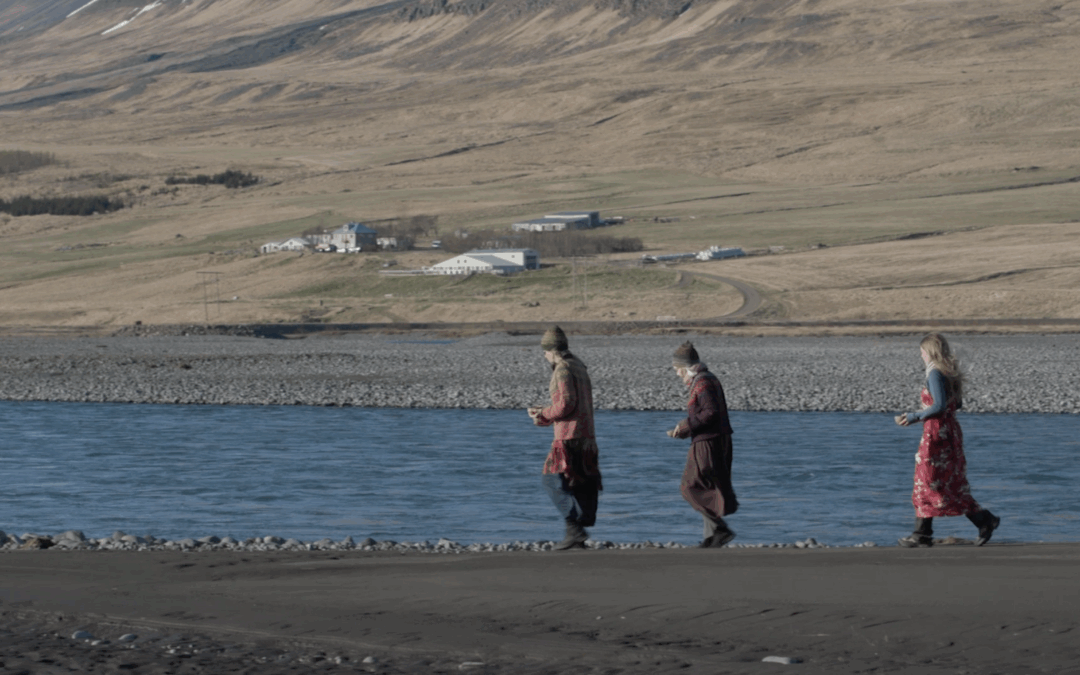
The work, Milky Rivers: Spices in the Current, originates in a performance carried
out at the glacial river, Héraðsvötn in Skagafjörður, near the exhibition site in
Héraðsdalur. Prior to the performance, unfired clay bowls were formed in
Borghildur’s studio. Left unfired, the clay easily returns to the earth and merges with
the landscape.
Turmeric and cardamom were placed in the bowls, brought by Ósk from the banks
of the glacier river, Ganges in India, originating in the Himalayas that has connected
cultures for centuries. The bowls were then set afloat into the river.
The video work documents the performance. Hulda Ragnhildur composed and
performs the soundscape, developed from a stone performance at the river, the
sound is transformed into an electronic composition underpinning the video.
Alongside the video is a drawing by Borghildur depicting the source of the river at
Hofsjökull glacier, where waters emerge, flowing like milk from the glacier’s udder.
Around 1980, a fifteen-year-old girl spends two summers in Höfn, a fishing town on the southeast coast of Iceland. She works in the local fish factory, surrounded by women who talk as they work. Stories pass between them, about husbands, neighbours, daughters, things that have happened in the town. There is laughter. The girl listens. She faints. She is lying on the wet factory floor, surrounded by women and fish.
On weekends, sveitaball at Sindrabær. People come from farms and fishing boats, from long days and weeks in the factory. All generations gather under the same roof. Bands play through the night. People drink, dance, embrace one another, quarrel, disappear outside and return. The air is thick with music, bodies and voices. At times it feels as though the building itself might burst.
By morning, the town returns to its ordinary life.
Sindri was a master craftsman in Norse mythology. He forged objects of extraordinary power.
More than forty years later, the girl returns. She is no longer a girl, and Sindrabær is no longer a community hall. It has become a music school. But the stage is still there.
The smell of the place, the darkness of the room. Everything comes back at once. She can hardly breathe. The songs begin, one after another, somewhere inside her.
Hávaxnar, léttlindar, lágvaxnar, þær líða sem í draumi, minningunum í. Grátbólgnar, grimmlindar, vergjarnar …
A fixed camera records the stage. Stagehands enter and leave, carrying instruments, amplifiers and other equipment, arranging and rearranging them, then removing them again.
The artist reads lyrics from popular Icelandic songs of the period, as poems. An electronic composition by Hulda Ragnhildur Hjálmarsdóttir gradually enters, with faint traces of the original songs woven into the sound.
The ghosts of time. Zeitgeist.
SINDRABÆR was presented as part of Nr. 5 Umhverfing, a site-specific art exhibition in southeast Iceland in 2024.
„Þar sem hrímið draup varð af kýr sú er Auðhumla hét, en fjórar mjólkár runnu úr spenum hennar. Kýrin sleikti hrímsteinana er saltir voru. Hinn fyrsta dag er hún sleikti steina kom úr steininum að kveldi mannshár, annan dag mannshöfuð, þriðja dag var þar allur maður“.
Á meðan Gláma var ennþá jökull gat hún af sér fölhvítan vökva sem streymdi um Sjónfríð og hásléttuna og botn Borgarfjarðar. Mjólká hélt leiðar sinnar niður borgir og stalla, tvístraðist við Borgarhvilft í tvær ólíkar en liðugar systur sem ummynduðust í miðjum klíðum í spriklandi kliðmjúka fossa. Hafið ekki langt undan með opinn faðminn. Jökullinn hvarf með tímanum og mjólkurliturinn líka – en vatnasvið Glámu hélt áfram að næra bunurnar tvær. Þar til miðlun hófst með stíflum, stáli og þrýstipípum. Í framhaldinu línukerfi yfir háar heiðar Vestfjarða, sæstrengir yfir ála Arnarfjarðar og Dýrafjarðar. Mjólkárveita. Tangavatnsmiðlun. Hofsárveita. Mjólká I, Mjólká II, Mjólká III.
Þjóðhátíðarsumar við Mjólkárvirkjun í Arnarfirði. Þrír mánuðir á afviknum stað, ég hafði aldrei dvalist svo lengi frá foreldrum mínum og systur. Upplifði söknuð í fyrsta sinn. Þarna var þríbýli og enn búskapur, áin streymdi á milli bæjarins og okkar, ég rölti gjarnan yfir brúna og fylgdist með mjöltum í fjósinu. „Hver á þig?“ spurði bóndinn og ég skildi ekki hvað hann átti við. Mitt heimili var heimili yfirverkfræðings Mjólkárvirkjunar sem var aðalmaðurinn á svæðinu og stjórnaði virkjanaframkvæmdum. Áfangi no 2 í bígerð. Fyrsta vinnan mín í lífinu tengdist virkjanaframkvæmdum. Ég lærði að baka kleinur og flatkökur og passaði Ásgeir og Jóhannes Lofts og Þórusyni. Kristín í móðurkviði. Við Ásgeir smíðuðum kofa og við Ragna, amma drengjanna spjölluðum saman, urðum trúnaðarvinkonur. Enn féll Mjólká af krafti niður hlíðina. Þetta var síðasta sumarið og dramatíkin lá í loftinu.
“What came next was that, as the rime dripped, it gave rise to a cow named Audhumla, and four milk rivers streamed from her teats. She fed Ymir.”
While Gláma was still a glacier, it exuded a pale white liquid which streamed around the mountain Sjónfríð, over the highland, and into the bottom of a fjord, Borgarfjörður. Mjólká—“Milk River”—made its way over cliffs and ledges and split at the Borgarhvilft cirque into two distinct, lithe sisters that morphed mid-ru into leaping, wriggling falls. Just ahead: the sea and its wide embrace. The glacier vanished and its milk color too—but the Gláma watershed kept nourishing the two torrents, until diversions began, dams, steel, pressure pipes. Resulting in a power grid over the high West Fjords heath, a submarine cable over deep channels of Arnarfjörður and Dýrafjörður. The Mjólká Power Plant. The Tangavatns Reservoir. Hof River Power Plant. Milk River I. Milk River II. Milk River III.
That “Summer of the National Holiday”—1974, Iceland’s 1100th birthday—at the Milk River Power Plant in Arnarfjörður. I had never been away from home so long. Endured homesickness for the first time. A three-farmhouse farm there, still farming, and the river flowed between the farm and us. I often trotted over the bridge to the barn at milking time, to watch. “Who do you belong to?” asked the farmer. I didn’t know what he meant. My home was the home of the lead engineer on the Mjólká Hydroelectric Project, now in the final stages of Phase II. My life’s earliest work had to do with the power plant construction. I learned to make crullers and bake flatcakes, and to babysit. Ásgeir and I hammered together a cabin, and Ragna, the lads’ grandmother, and I became confidantes. Mjólká still fell forcefully down the slope. This was the last summer, and drama lay in the air.
Video installation, Stóra-Klofi, Landsveit, Iceland 2020
For centuries, sheep have lived alongside humans in Iceland, shaping the landscape with their narrow paths, grazing the hillsides, providing food, wool and warmth. A long history of familiarity and dependence, of tenderness and control.
In the video, the artist is seen from behind, drawing sheep gathered with their newborn lambs inside a barn. She follows their shapes and movements, attempting to come closer, to understand, perhaps to capture something of these familiar yet elusive creatures.
Sheep arrived in Iceland with the first settlers and have since become deeply woven into everyday life, into the landscape, language, food and clothing. Humans have tended to them, sheltered them, gathered and separated them, generation after generation.
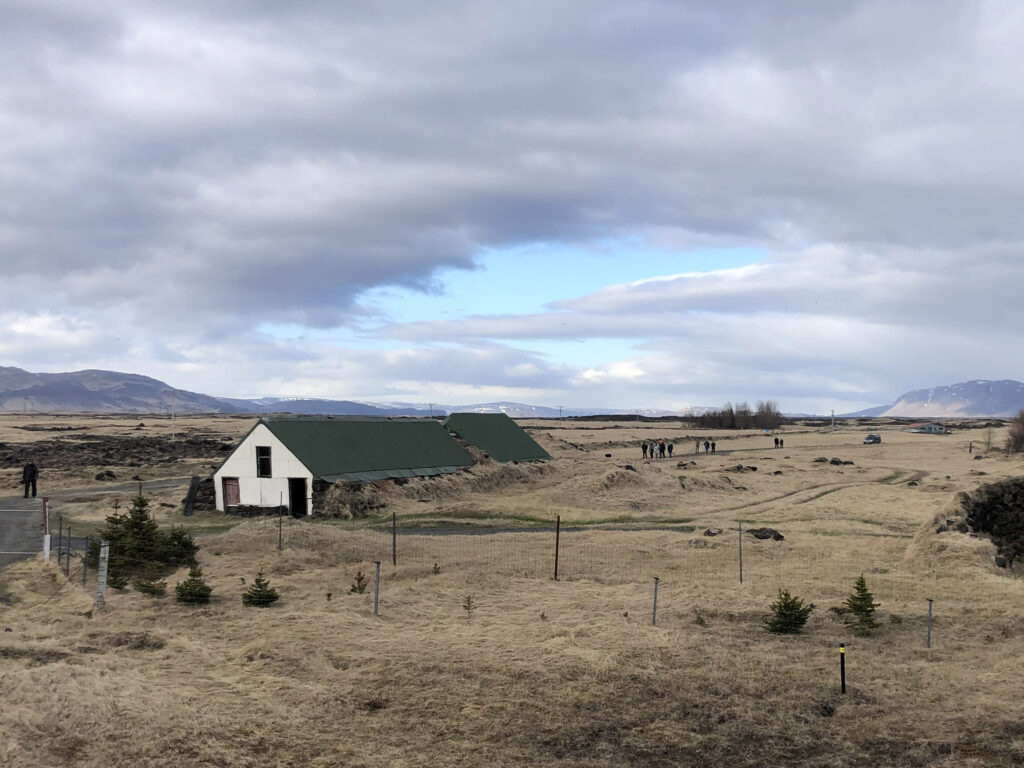
The video was projected directly onto the rough stone walls of a disused sheep barn at Stóra-Klofi in southern Iceland. The moving images merge with the uneven surfaces, the animals appearing and disappearing among the stones, returning for a moment to a place once inhabited by their own kind.
KIND was presented as part of the exhibition LANDVIST in 2020.
Kind = sheep in Icelandic/ gentle in English/ child in German.